A YORKSHIREMAN'S TRAVEL GUIDE

Brussels, Belgium
August, 2026
First Thoughts
Belgium has always been another European country that I’ve wanted to explore in detail, and in March 2026 I booked six days staying in Brussels to give myself something to look forward to. It was only after that that I got my job going to Cambodia, and found myself with a packed summer holiday, a total of five weeks out of the UK. Unlike a lot of my other journeys, it also left me with not very much time to spend organising the trip, and I only booked my flights, accommodation, trains and a ‘Brussels Card’ ahead of departure.
I didn’t have heavy expectations for Belgium, having only ever travelled through the country or visited when I was very young. It’s not a country with a well-known culture in comparison to its neighbours, such as the Netherlands or France, but it’s also often called ‘the capital of Europe’, home of the European Union (EU) and NATO. I booked my flights from Brussels Charleroi Airport as it was half the price of Brussels Central Airport, a move to which one of my friends said: “You might as well get a second flight from Brussels Charleroi to Brussels Central”.


Day One
On day one, I left my local train station at a reasonable time, heading to my usual departure airport these days, Manchester Airport. I was quickly through the airport check-in and security system and had some time to myself in the duty-free to plan my trip. After a short flight, I arrived at Brussels Charleroi Airport, which, it turns out, is about as ‘London’ as London Luton, Stansted or Southend airports are, Charleroi actually being a completely different city to Brussels. I had booked a train from Charleroi West, the closest station to the airport, and took a bus into the city centre. In Charleroi, I then walked across the city centre from the bus station to Charleroi West.
Charleroi West, pictured, was one of the most barren train stations that I have ever seen, with weeds growing through the platform and the steps, no office, toilets or ticket machine of any kind. Unfortunately, Charleroi West’s bareness was my downfall. As I stood on the platform in its centre, I could see a platform on the far side that looked entirely disused, as there was a concrete wall behind it with almost no way to enter, except near the end where the wall fell away. Unfortunately, my train pulled in at the platform, and the hole in the wall was, in fact, an official entry point, so I missed my train.
Luckily, my ticket involved a change back at Charleroi Central for twenty minutes, so I took the slightly demeaning walk back to the main station, where I THEN managed to get on my train. I switched at Brussels-Midi, one of Brussels’ main stations, and took a short train up to Brussels-Nord, the nearest large station to my hostel. Immediately, when walking out of Brussels-Nord, it felt different from the other big European cities I’ve been to, as there were large groups of men with their hoods up and just hanging around at the exit of the station. A few of them tried talking to me as I walked past with my suitcase, but I just ignored them.
From Brussels-Nord, it was a twenty-minute walk up to Jacques Youth Hostel, where I would be staying for the next few days. I settled into the hostel well, and found the way of life here, at least from the Belgians, to be relatively relaxed and friendly without being over-friendly. For dinner, I headed down the road to a small restaurant called Le Petite Cascade, where other tourists were eating, and I had a lasagne with a Duvel to drink, my first Belgian beer of the trip. I picked up some bits for lunch at a local shop, part of a chain called Shop & Go, before heading back to the hostel for bed.
Images:
- Top left: My aeroplane at Manchester Airport
- Top right: Charleroi West train station
- Bottom left: Brussels-Midi train station
- Bottom right: Sunset view from Jacques Youth Hostel
Day Two
My first full day in the city started with breakfast at the hostel – a regular continental breakfast, before I headed out for a swim at the nearest swimming pool in the city, called Zwembaden van Sint-Joost. The pool was presented as similar to a fine old Victorian swimming bath, and cost $4, cheaper than almost any public pool in the UK at the moment. After I’d swum some lengths in the pool, I returned to the hostel and got myself ready for the day ahead, where I was planning to explore the main attractions in Brussels City Centre.
From the hostel, I took a tram from my nearest stop down to The Royal Palace. To my dismay, I found that the Palace was not included in the Brussels Card deal, and was only open to the public for five weeks during the summer, closing just after I’d arrived in the city. Directly next to (attached, in fact) the Palace was The BelVUE museum, which was included in the card, a museum covering the history of Belgium. Inside, I was surprised to learn that Belgium was a much newer country than I thought, having been declared an independent nation from the Netherlands after the USA separated from the UK. The museum also went into some depth about King Leopold II, the second Belgian King, and his actions in the Democratic Republic of Congo, more so than I expected.
From the BelVUE, and the gardens in front of the palace where I had my lunch, I then headed eastwards towards one of the main Brussels institutes: The European Union Parliament. The headquarters of the entire Union, along with one of two parliamentary chambers, can be found in Brussels, and attached to them is a free and extensive visitor centre. Luckily, despite the UK not being in the EU anymore, we are all still on good enough terms that British visitors are allowed in the visitor centre. Inside, I found many diagrams, displays and videos detailing the history of the Union.
From the Union, I walked across Leopold Park to the Belgian Natural History Museum. It was one of the larger Natural History Museums I’ve visited since my travels began, only smaller than Berlin and London. Inside was a range of stuffed modern-day animals, but for me the main attraction was the large range of dinosaur fossils, which included but was not limited to: A Tyrannosaurus Rex, an Allosaurus, A Stegosaurus, and nine fully-grown Iguanodons, which were part of the large collection of dinosaur skeletons to be found together. After leaving the museum, I took the Brussels metro westwards into the city centre.
I arrived in Brussels city centre, having booked tickets to see the new Spider-Man film (it had come out the day after I’d left for Cambodia, and I’d had no chance to watch it), and rushed around trying to find somewhere decent to eat before the film. I came across a restaurant called Brasserie Le Serf, on the edge of Brussels’ main square, Grand Place, and asked the waiter what could be done quickly. He pointed to a blackboard with chalk writing entirely in French, and told me the day’s special. I said yes to what then turned out to be a huge pan of mussels with chips. Despite my surprise, the dinner was fantastic, and I headed on to the cinema before taking a tram back to the hostel as it got dark.
Images:
- Top left: The Royal Palace of Brussels
- Top right: Myself at the entrance of the European Union Visitor Centre
- Bottom left: T-Rex skeleton in the Belgian Natural History Museum
- Bottom right: Stadhuis van Brussel hotel on Grand Place Square


Day Three
I had a slightly later-than-planned start on the third day, when I planned to go to Ottignies-Leuvain-La-Neuve, a small university town on the outskirts of Brussels. I took the train from the nearest station to my hostel, Brussels-Congrès, and headed out to the town. Ottignies-Leuvain-La-Neuve isn’t just any old place; it’s a planned town built to house the Catholic University of Leuvain, with a car-free town centre, which opened in 1972. As well as a nice little town, most importantly, it’s also home to the Hergé Museum.
Once I’d arrived in the town, I went around the shopping centre in the town centre before having my packed lunch in the town park, Source Park, an enclosed park with benches and a play park. After my lunch, I headed to the Musée Hergé, or Hergé Museum, a large glass structure which appears out of the trees as you walk towards it. The museum is fascinating, particularly for anyone who, like me, is a big Tintin fan, full of exhibits on the history of Hergé, exclusive sketches, details on every Tintin story, and of course, plenty of related merchandise in the museum shop. A very interesting visit, although it does leave the visitor asking the question of why the museum isn’t in the centre of Brussels or one of the other large Belgian cities.
After visiting the museum, I made my way through the centre of the town to a museum I’d seen on Instagram called the Musée L, or University Museum of Louvain, which was being posted about due to its range of contents. I managed to get into the museum for free using my British Blue Light Card, which was a nice bonus, and managed to get round the museum relatively quickly, in about 45 minutes. Its contents included a range of artwork from all corners of the globe, as well as science equipment and diagrams, most of which related to the university in some way.
Afterwards, I went for dinner on the university campus ahead of my return train. I ate at the Green Mango burger bar in one of the university squares, and had a couple of drinks at the Dude! bar. Dude! was an interesting visit, absolutely packed out as the summer holidays came to an end; a rock bar with various guitars and a motorbike hanging from the ceiling. I returned to Brussels on the train, which took just under an hour, and stopped on my walk back to the hostel to photograph an amazing sunset over the buildings opposite the hostel.
Images:
- Top left: French-language edition of The Lord of the Rings
- Top right: Chandelier in the Herge Museum
- Bottom left: University Museum of Louvain
- Bottom right: Burussels-Noord train station
Day Four
Day Four was the day I wanted to visit the attractions outside of Brussels’ city centre, which involved going to two different sections of the suburbs. I started the day with another swim in Zwembaden van Sint-Joost, before heading back to the hostel to get ready for the day. I took a Metro from my closest station to Heysel, the end of one of the lines. It was there that I found two major tourist attractions: Mini-Europe and The Atomium.
The first one I visited was Mini-Europe, an EU-supported model village of grand buildings from every country in Europe (it was, in fact, every country in the EU, plus the UK, which had been in the EU at the time the attraction had been made). Walking around the extensive attraction, I was impressed by the range of different models, and the skill that went into making them. I was particularly impressed by models of places I’d been to in recent travels, such as Berlin’s Brandenburg Gate, Copenhagen’s Nyhavn street, and Brussels’ Grand Place, which I had seen for real just two days before. The attraction took roughly an hour and a half to walk around, and ended with an exhibition called Spirit of Europe, which taught me more about the history of the European Union.
After Mini-Europe, I had lunch on the benches outside the attraction, and added a cone of chips with mayonnaise to my lunch.
From there, I walked over to the main attraction in this area of the city, and perhaps the most iconic Brussels building, The Atomium. Covered by the Brussels Card, The Atomium is a huge atom-like metal structure, which comes in two parts – in the lower ‘balls’, or electrons, there is an exhibition that covers the history of the Atomium. First opened for the 1958 World's Fair in Brussels, it remained open after the fair because of its popularity and underwent a major renovation in 2006, which left it in the well-maintained condition it is in today. The second part of the attraction involved a lift ride to the top electron, to a viewing station from which the rest of Brussels can be seen, and a fancy restaurant where I bought a lemonade (for only 7 euros!).
I left that area of Brussels containing the Atomium and Mini-Europe, known as Laeken, and took the metro line back towards the centre of the city. I changed for a tram at Midi, and headed south of the city centre, towards another attraction I’d found through Instagram: The Maniak Padou Climbing centre. On first approach to Maniak Padou, you might not be blamed for thinking that you were in the wrong place – the church it is found in, from the outside, looks run-down and all the windows are darkened. Once inside, however, it is a lively and impressive small climbing centre, with one small room for bouldering as well. I climbed a few of the bouldering routes, but the centre did lack easier routes, and I had my dinner from the centre’s pizza bar before I made my way back to the hostel on public transport.
Images:
- Top left: Mini-Europe in the foreground, with The Atomium in the background
- Top right: Mayonnaise and chips outside Mini-Europe
- Bottom left: The Atomium
- Bottom right: Maniak Padou Climbing Centre


Day Five
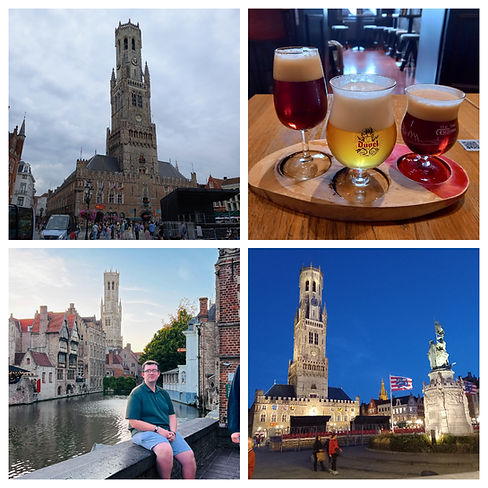
Day five was my final full day in Belgium, and was almost certainly the day that I was most looking forward to. I was up relatively early, and out on the train to the city of Bruges, Belgium’s sixth-largest city, and one distinguished as a place of major historical importance and now a UNESCO World Heritage site. I had visited the city in 2005 with my family for one day, but I could barely remember that trip, and was looking forward to revisiting the place as a well-travelled adult.
Unlike the larger Brussels, which seems to be half-dedicated to public transport systems, Bruges only has one large train station, and it is a couple of kilometres away from the city’s historic market town centre. Once out of the station, I hired a Blue bike from the station bike depot and cycled down the cobbled streets, making my way roughly towards The Belfry, which stood above the skyline in the middle of the city. I parked my bike up in The Market Square. My first visit was The Salvador Dalí Museum, a small art museum at the bottom of the Belfry.
The skies then opened, and I ate my packed lunch in one of the sheltered archways at the bottom of the Belfry, having foolishly decided that today was the day not to bring my raincoat, as it had not rained for the last four days. I then bought a ticket to The Historium, a history museum of Bruges itself, which started with a room-to-room tour with effects and actors, definitely aimed more at children than me. Inside the Historium, there was a bar called The Duvelium, a licensed Duvel pub where you could buy Duvel alongside a range of other Belgian wheat beers. The final part of the Historium was a large tower, which you were warned was ‘extremely thin ’, and anyone wishing to do it had to fit through a hole in cardboard they provided (they only did this after you’d paid to go up). I just fit through and ascended the 150 steps to the top of the tower, where you walk out onto an extremely narrow balcony, giving you a great view of the central Market Square.
I headed into the city shopping area and went into a café called The Old Chocolate Shop, where I bought a huge Biscoff hot chocolate, where you had to drop a lump of chocolate into a mug of hot milk and mix it in yourself. After that, I purchased a ticket for the inevitable – a climb up to the top of the Belfry. The Belfry is Bruges’ most iconic building, a huge tower which features heavily in the finale of the film In Bruges. 366 steps later, I was at the top and took in the view of the city. I also bumped into a man I recognised from my room in the Jacques hostel, and after we laughed off the coincidence, we decided to go and get a beer together.
We enjoyed a few beers in the end, and ended up buying dinner in a nice burger restaurant next to one of the city’s many canals. We agreed to get the same train back to Brussels, and I cycled (this time in the dark) whilst he walked. Once back in Brussels, my new friend declared that he was too tired to walk all the way back from Brussels Central Station to the hostel, so we used the Dott system to rent vehicles, myself on an e-bike and him on an e-scooter, respectively. This blast of a ride through the city centre and back to the hostel was an amazing way to end the trip.
Images:
- Top left: The Belfry of Bruges
- Top right: Beer tray in the Duvelium
- Bottom left: Myself sat on the edge of a canal near The Belfry
- Bottom right: The Belfry of Bruges at night
Day Six
The final day began promptly, as I checked out of the hostel after breakfast and made my way back to Brussels-Nord. I took the full reverse of the journey I’d taken to get to the hostel, taking two trains to get me back to Charleroi-Central train station, where I then got on a bus to the airport. I gave myself two hours and twenty minutes at the airport and felt that this would be plenty of time; however, I found myself queuing at almost every point: check-in, security and boarding, not stopping at any point. I departed Belgium, taking a short flight back to Manchester. After two trains, a bus, a plane, a second train in the UK and an Uber, I made it home.
Images:
- Top left: Exterior of Brussels-Noord station
- Top right: Brussels city centre skyscrapers
- Bottom left: Brussels-Noord train station
- Bottom right: My aeroplane at Brussels-Charleroi airport

Final Thoughts
Overall, Brussels itself left me fairly disappointed; the city has a huge amount of poverty, and whilst it styles itself ‘the capital of Europe ’, this is certainly a political title and not a cultural one. Don’t go to Brussels expecting it to be comparable to a city like London, Paris or Berlin. Despite the less desirable areas of the city, Brussels does have a significant number of tourist attractions, and the greatest ones it wears on its sleeve, such as the Atomium and the EU Parliament building.
My ventures into wider Belgium were more interesting, with Louvain-la-Neuve being a recommendation for anyone visiting central Belgium and wanting a more relaxed day in their itinerary. Bruges was both busy and expensive, but it feels like the genuine article, a city with culture, history, food, atmosphere and an all-round ‘nice vibe’. I think if I go back to Belgium, I’ll stay there and venture out to Antwerp and Ghent.
Useful Links
www.visit.brussels/en/visitors - Brussels official tourism website
www.visitbruges.be/en - Brugges official tourism website
https://visitbelgium.com/ - Belgium official tourism website
https://european-union.europa.eu/index_en - European Union official https://smarthostels.com/hostels/smart-russell-square - Smart Russel Square Hostel official website
